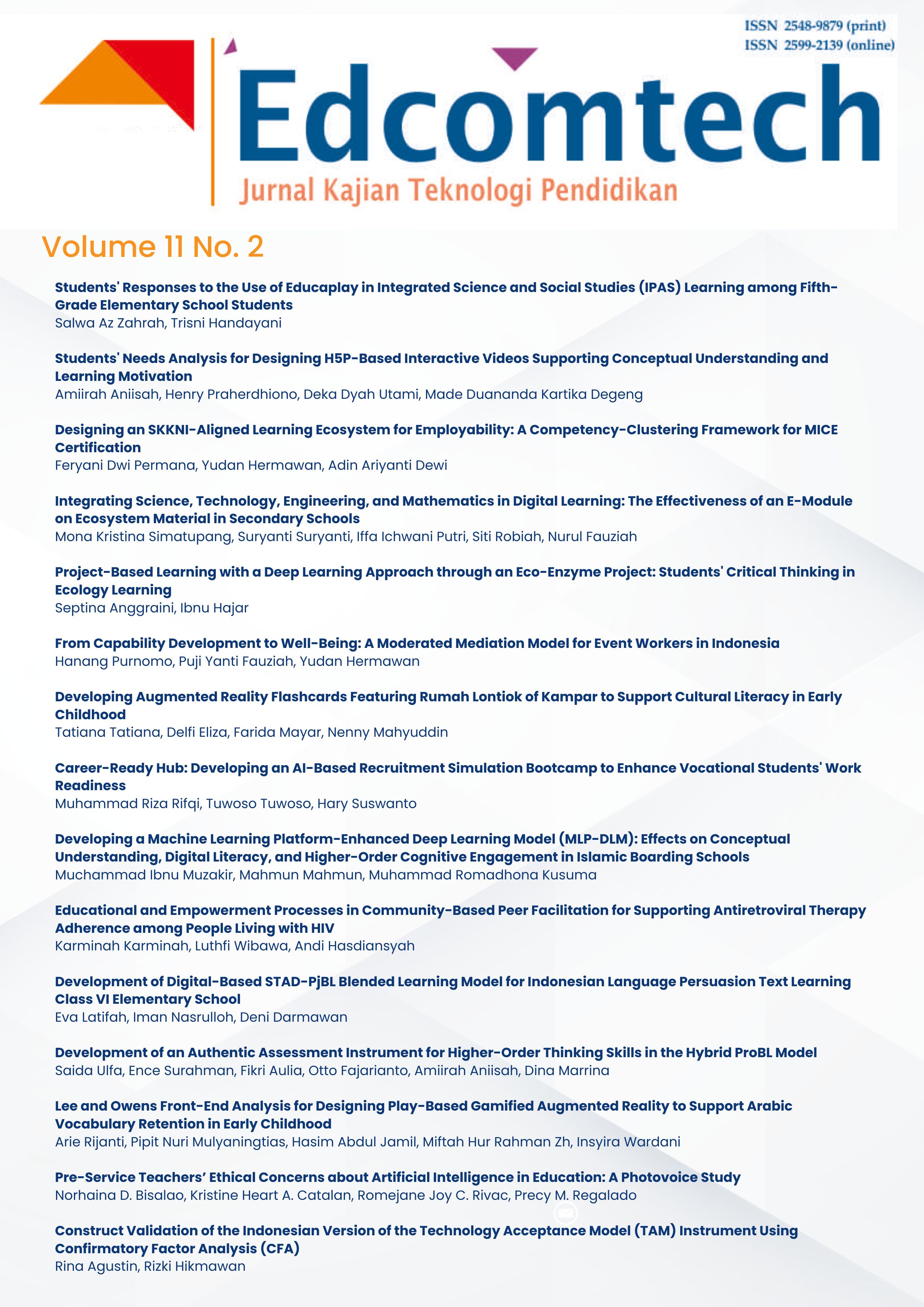
Development of Digital-Based STAD-PjBL Blended Learning Model for Indonesian Language Persuasion Text Learning Class VI Elementary School
DOI:
https://doi.org/10.17977/um039v11i22026p373-387Keywords:
Blended Learning, STAD, Project Based Learning, Persuasive Text, Elementary SchoolAbstract
Indonesian language instruction at SDN 2 Sukaratu faces unequal technology access among sixth-grade students, while a student survey indicated a continued need for face-to-face guidance. This study develops a blended learning model combining offline instruction using the STAD cooperative model with online instruction using a digital-based Project Based Learning (PjBL) model for the Persuasive Text unit in Grade VI, and examines its feasibility through expert validation. The study used a Research and Development approach following the ADDIE model adapted into five procedural stages: needs analysis, design, development, implementation, and evaluation/revision. The products were a learning website/Learning Management System (LMS) and an e-module (e-module). Feasibility was examined through validation by three experts (instructional design, content, multimedia) using scaled questionnaires, followed by a one-to-one trial with 20 students. Expert validation showed feasibility scores of 84.2% (design), 86.5% (content), and 83.8% (multimedia), all in the very feasible category based on established percentage-interpretation criteria. The one-to-one trial showed a mean N-Gain of 0.61 (medium category). The digital-based STAD-PjBL blended learning model is feasible as an alternative Indonesian language teaching strategy for elementary schools with limited technology access, while its effectiveness on learning outcomes requires further study based on field-trial data.
References
Akbar, S. (2013). Instrumen Perangkat Pembelajaran. PT Remaja Rosdakarya.
Al Fisani, M., Mulyani, W., & Rahayu, Y. (2025). Peningkatan Motivasi Belajar Bahasa Indonesia melalui Model STAD pada Siswa Kelas VI UPT SDN Kingking 1 Tuban. Jurnal Penelitian Pendidikan Indonesia (JPPI), 2(3), 78-82. https://doi.org/10.62017/jppi.v2i3.4182
Amelia, A. (2025). Studi Literatur: Penerapan Metode Blended Learning Terhadap Motivasi Belajaran Anak Sekolah Dasar. Jurnal Teknodik, 23-32. https://doi.org/10.32550/8832jm89
Bilqis, A., Iswara, P. D., & Aeni, A. N. (2023). Pengembangan E-Book Interaktif untuk Meningkatkan Kemampuan Menulis Paragraf Argumentasi Kelas IV. Diglosia: Jurnal Kajian Bahasa, Sastra, Dan Pengajarannya, 6(2), 437-448. https://doi.org/10.30872/diglosia.v6i2.628
Branch, R. M. (2009). Instructional design: The ADDIE approach. Springer.
Colognesi, S., Coppe, T., & Lucchini, S. (2023). Improving the oral language skills of elementary school students through video-recorded performances. Teaching and Teacher Education, 128, 104141. https://doi.org/10.1016/j.tate.2023.104141
De Bruijn-Smolders, M., & Prinsen, F. R. (2024). Effective student engagement with blended learning: A systematic review. Heliyon, 10(23), e39439. https://doi.org/10.1016/j.heliyon.2024.e39439
Dewey, J. (1938). Experience and education. Macmillan.
Fahrezi, I., Taufiq, M., Akhwani, A., & Nafia’ah, N. (2020). Meta-Analisis Pengaruh Model Pembelajaran Project Based Learning Terhadap Hasil Belajar Siswa Pada Mata Pelajaran IPA Sekolah Dasar. Jurnal Ilmiah Pendidikan Profesi Guru, 3(3), 408–415. https://doi.org/10.23887/jippg.v3i3.28081
Fatchiyah S, R., Rondli, W. S., & Ermawati, D. (2024). Penerapan Student Teams Achievement Division untuk Meningkatkan Hasil Belajar Siswa Sekolah Dasar. Jurnal Pendidikan Dan Pembelajaran Indonesia (JPPI), 4(3), 1197–1206. https://doi.org/10.53299/jppi.v4i3.701
Ferrero, M., Vadillo, M. A., & León, S. P. (2021). Is project-based learning effective among kindergarten and elementary students? A systematic review. PloS one, 16(4), e0249627. https://doi.org/10.1371/journal.pone.0249627
Firdaus, S., Isnaeni, W., & Ellianawati, E. (2018). Motivation and learning achievement of primary students in theme-based learning using blended learning model. Journal of Primary Education, 7(3), 324-331. https://doi.org/10.15294/jpe.v7i3.24225
Graham, C. R. (2006). Blended learning systems: Definition, current trends, and future directions. In C. J. Bonk & C. R. Graham (Eds.), The handbook of blended learning: Global perspectives, local designs (pp. 3–21). Pfeiffer.
Güngör, F., Altunbaşak, İ., Aydın, A. T., Kaya, M., & Erdem, C. (2026). A second-order meta-analysis on the effects of cooperative learning on students’ academic achievement, higher-order thinking, and affective behaviors. Current Psychology, 45(6), 552. https://doi.org/10.1007/s12144-025-08943-0
Hadeli, H., Sugara, N., Elismawati, E., & Al Azmi, H. (2022). A Meta Analysis Study of the Student Teams Achievement Divisions (STAD) Method in English Teaching and Learning. Al-Ta lim Journal, 29(3), 245-252. https://doi.org/10.15548/jt.v29i3.815
Hake, R. R. (1998). Interactive-engagement versus traditional methods: A six-thousand-student survey of mechanics test data for introductory physics courses. American journal of Physics, 66(1), 64-74. https://doi.org/10.1119/1.18809
Li, S., & Wang, W. (2022). Effect of blended learning on student performance in K‐12 settings: A meta‐analysis. Journal of Computer Assisted Learning, 38(5), 1254-1272. https://doi.org/10.1111/jcal.12696
Mustanil, M., Hady, M. S., & Kawakip, A. N. (2022). Efektivitas Penggunaan Model Blended Lerning dalam Meningkatkan Motivasi dan Hasil Belajar Siswa MI Darul Hikmah Bone. Jurnal Basicedu, 5(6), 6453–6463. https://doi.org/10.31004/basicedu.v5i6.1687
Nirmayani, L. H., & Dewi, N. P. C. P. (2021). Model pembelajaran berbasis proyek (project based learning) sesuai pembelajaran abad 21 bermuatan tri kaya parisudha. Jurnal Pedagogi Dan Pembelajaran, 4(3), 378-385. https://doi.org/10.23887/jp2.v4i3.39891
Piaget, J. (1973). To understand is to invent: The future of education. Grossman Publishers.
Pierce, G. L., & Cleary, P. F. (2024). The persistent educational digital divide and its impact on societal inequality. Plos one, 19(4), e0286795. https://doi.org/10.1371/journal.pone.0286795
Puspitasari, S., Hayati, K. N., & Purwaningsih, A. (2022). Efektivitas Penggunaan Model Blended Learning Terhadap Motivasi Belajar dan Hasil Belajar IPS. Jurnal Basicedu, 6(1), 1252–1262. https://doi.org/10.31004/basicedu.v6i1.2186
Rafiola, R., Setyosari, P., Radjah, C., & Ramli, M. (2020). The effect of learning motivation, self-efficacy, and blended learning on students’ achievement in the industrial revolution 4.0. International Journal of Emerging Technologies in Learning (iJET), 15(8), 71-82. https://doi.org/10.3991/ijet.v15i08.12525
Rohana, R. S., & Wahyudin, D. (2016). Project based learning untuk meningkatkan berpikir kreatif siswa SD pada materi makanan dan kesehatan. Jurnal Penelitian Pendidikan, 16(3), 235-243. https://doi.org/10.17509/jpp.v16i3.4817
Slavin, R. E. (1995). Cooperative learning: Theory, research, and practice (2nd ed.). Allyn & Bacon.
Sumilat, J. M., & Matutu, V. S. (2021). Model Pembelajaran Kooperatif Tipe STAD (Student Teams Achievement Divisions) Untuk Meningkatkan Hasil Belajar Sisiwa Sekolah Dasar. Edukatif: Jurnal Ilmu Pendidikan, 3(3), 865-870. https://doi.org/10.31004/edukatif.v3i3.392
Tong, D. H., Uyen, B. P., & Ngan, L. K. (2022). The effectiveness of blended learning on students' academic achievement, self-study skills and learning attitudes: A quasi-experiment study in teaching the conventions for coordinates in the plane. Heliyon, 8(12). https://doi.org/10.1016/j.heliyon.2022.e12657
Vygotsky, L. S. (1978). Mind in society: The development of higher psychological processes. Harvard University Press.
Wangge, Y. S., & Sariyyah, N. (2022). Peningkatan Motivasi dan Hasil Belajar melalui Model Pembelajaran Kooperatif Tipe STAD Berbantuan Media Gambar Tarian Gawi pada Siswa Sekolah Dasar. Jurnal Basicedu, 6(2), 1906–1913. https://doi.org/10.31004/basicedu.v6i2.2166
Zacharias, M. E. (2021). Metode Cooperative Tipe Stad Dapat Meningkatkan Hasil Belajar Tematik Bahasa Indonesia Materi Pembelajaran Menceritakan Kembali Teks Petualangan, Di Kelas Vi Sd Gmit Oebelo. Jurnal Ilmu Pendidikan (JIP), 6(1). https://doi.org/10.59098/jipend.v6i1.516
Zahara, R., Nasution, F. S., Yusnadi, Y., & Surya, E. (2022). Implementasi Pembelajaran Blended Learning di Jenjang Sekolah Dasar. Jurnal Basicedu, 6(4), 6482–6490. https://doi.org/10.31004/basicedu.v6i4.3189
Zhang, L., & Ma, Y. (2023). A study of the impact of project-based learning on student learning effects: A meta-analysis study. Frontiers in psychology, 14, 1202728. https://doi.org/10.3389/fpsyg.2023.1202728
Downloads
Published
How to Cite
Issue
Section